
The glute bridge is the most searched glute exercise in the world right now, and the most commonly performed badly. It looks too simple to get wrong, which is exactly why so many people do hundreds of them and feel nothing.
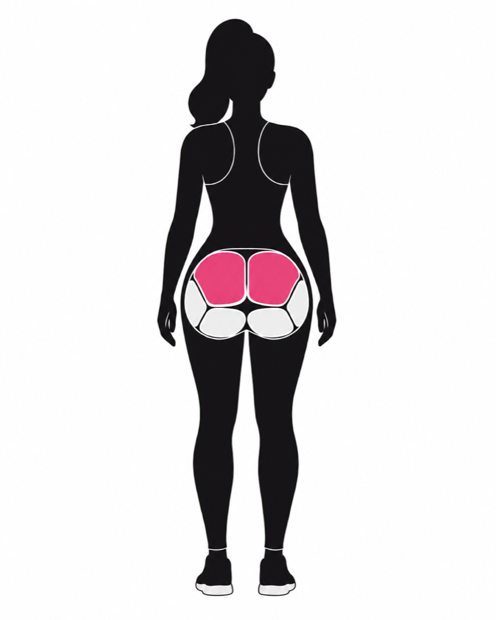
The setup
- Lie on your back, knees bent, feet flat on the floor.
- Bring your heels close enough that your fingertips can just brush them.
- Feet hip-width apart, toes pointing straight ahead.
- Arms flat by your sides, palms down.
- Tuck your ribs down slightly so your lower back is not arched before you start.
The rep
Push through your heels and lift your hips until your body makes a straight line from knees to shoulders. Squeeze your glutes hard at the top for one full second. Then lower slowly, taking about two seconds, and stop just before your bum touches the floor to keep tension on the muscle.
- +Heels close enough to brush with your fingers
- +Full lockout, knees to shoulders in a line
- +One second squeeze at the top
- +Two seconds lowering
- –Stopping at 70 percent of the range
- –Arching your lower back to fake height
- –Bouncing off the floor
- –Feet too far from your body
The four mistakes
1. Stopping short
By far the most common. Most people lift to about 70% of full extension and lower again. The final 30% is where the glutes work hardest, so cutting it removes most of the benefit.
2. Arching the back instead of finishing the hips
If your lower back is doing the lifting, you will feel it there tomorrow instead of in your glutes. Keep the ribs tucked and think about pushing your hips toward the ceiling, not your chest.
3. Going too fast
Bouncing off the floor turns a strength exercise into a cardio one. Slow the lowering phase down. Two seconds down, one second squeeze.
4. Feet too far away
Heels far from your body shifts the work to your hamstrings. Walk them in until it feels almost uncomfortably close.
Cannot tell if you are reaching full lockout? Neither can most people, which is the whole problem. Butt Lift measures your hip angle on every rep and says "lift your hips higher" the moment you start cutting the range.
How to progress
- Week 1 to 2: bodyweight, 3 sets of 15, one-second holds.
- Week 3 to 4: add a two-second pause at the top, or a band above the knees.
- Week 5 to 6: single-leg bridges, 3 sets of 10 per side.
- Week 7 onward: elevate your shoulders onto a sofa for a full hip thrust, which increases range of motion significantly.
SL = single leg. Progress by difficulty, not just by adding reps.
Knowing whether your reps are actually good
Every mistake above is invisible while you are doing it. You cannot see your own hip angle, and by rep twelve your sense of "that felt like a full one" is unreliable.
Butt Lift solves this directly: point your phone at yourself and it measures the hip angle on every rep, scores it for depth and tempo, and says "lift your hips higher" the moment you start cutting the range. Shallow reps do not count toward your target, which is oddly motivating.
Stop guessing. Start scoring.
A personalised 28-day glute plan, and a camera that counts and scores every single rep you do.
Get Butt Lift Free to download. Free trial of everything.